October 1, 2026
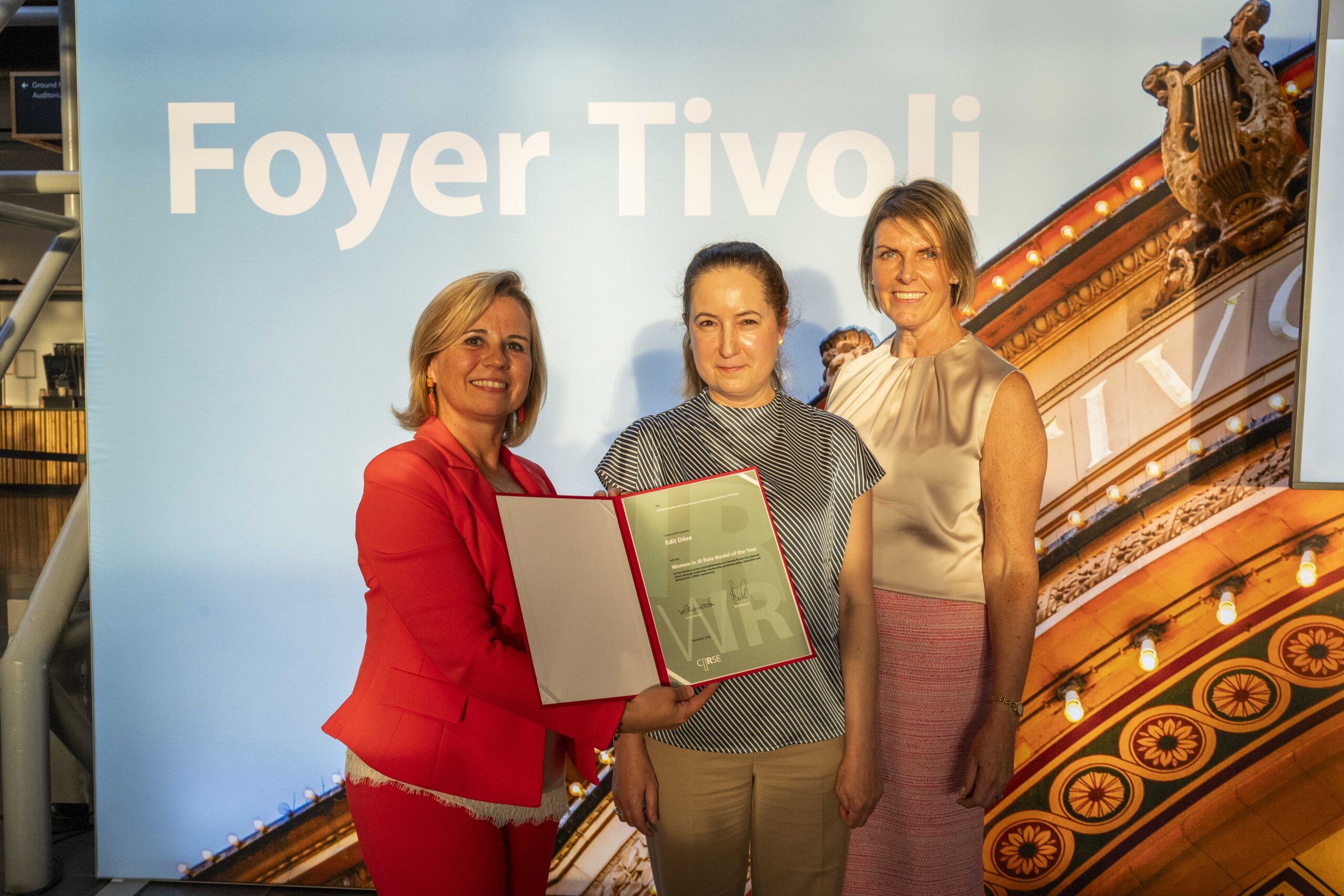
Prof. Edit Dósa received the Women in IR Role Model of the Year award at the Women in IR reception during CIRSE 2026. In this Q&A, she reflects on belonging, mentorship, and how the IR community can support women and young IRs.








Prof. Edit Dósa received the Women in IR Role Model of the Year award at the Women in IR reception during CIRSE 2026. In this Q&A, she reflects on belonging, mentorship, and how the IR community can support women and young IRs.
Prof. Dósa, congratulations on winning the Women in IR Role Model of the Year award! In your inspiring acceptance speech, one of your messages to younger women was not to wait until they feel completely ready to take on a professional challenge. Why do you think women in IR can sometimes feel a hesitation to put themselves forward or take chances?
Dósa: There is probably no single explanation, and the experience is not the same for every woman. However, women may still encounter fewer visible role models, may be judged by different expectations, or may feel that they need to meet every requirement before putting themselves forward. In a demanding specialty such as IR, a strong sense of responsibility can easily become excessive self-scrutiny. This is why encouragement and a direct invitation can be so important. Sometimes hearing “I think you are ready” is enough to help someone take the next step before complete confidence has arrived.
You spoke about the importance of telling younger colleagues, “You belong here.” Were there particular people or moments in your own career that gave you that sense of belonging?
Dósa: The first person who made me feel this very clearly was Alex Barnacle. A few years ago, we co-chaired the Women in IR session at the 2022 CIRSE Annual Congress, and several months before the congress we met on Zoom to discuss and prepare the session. That interaction gave me a genuine sense that I belonged and that my perspective was valued. It also reminded me that this feeling is often created through seemingly small things: being listened to, being treated as an equal, and being trusted with responsibility.
You noted the importance of both mentorship and sponsorship, saying that a mentor can offer direction while an industry sponsor helps ensure that someone’s work is recognized. Could you elaborate on this point?
Dósa: Representatives of sponsoring companies may be in a position to invite or recommend interventional specialists to contribute to industry-sponsored symposia, give presentations, or demonstrate devices and technologies used in interventional radiology. In that context, sponsorship means using those opportunities thoughtfully: looking beyond the most familiar names, recognizing expertise and potential, and helping ensure that qualified women and younger colleagues are considered and made visible.
You mentioned how excellence can be a source of confidence, but that excellence should not be confused with perfection. How can mentors help young doctors develop high standards without reinforcing the pressure to be flawless?
Dósa: Mentors can make it clear that high standards mean preparation, responsibility, honest reflection, and a commitment to continued improvement: not an expectation of never making a mistake. Specifically, constructive feedback is especially helpful when it recognizes what was done well and identifies what can be strengthened next.
Mentors can also speak openly about their own learning experiences and create an environment in which questions and uncertainty can be discussed without embarrassment. Young doctors should be challenged, but they should also understand that one difficult case or imperfect performance does not define their ability or their future.
You also spoke about women supporting and celebrating one another rather than seeing others’ success as a competition. Have you seen the culture around this change during your career in IR?
Dósa: I have seen a significant change during my career. Women in IR are certainly more visible than they were a few years ago, and there is more open discussion about the importance of supporting and recognizing one another. However, I would be cautious about describing this as a uniform or continuous trend, and I cannot say with certainty what has driven the change.
At the same time, I believe that we should not overemphasize gender. Equal opportunities are essential, but professional recognition and advancement should ultimately be based on competence, commitment, and achievement. Being a woman should neither place someone at a disadvantage nor, in itself, confer special privileges. The goal should be a professional culture in which everyone is evaluated fairly, and talent is recognized wherever it is found.