Prof. Vidal, what inspired you to choose the topic of your Andreas Gruentzig Lecture, “From emerging countries to space missions: building interventional radiology where it does not yet exist”?
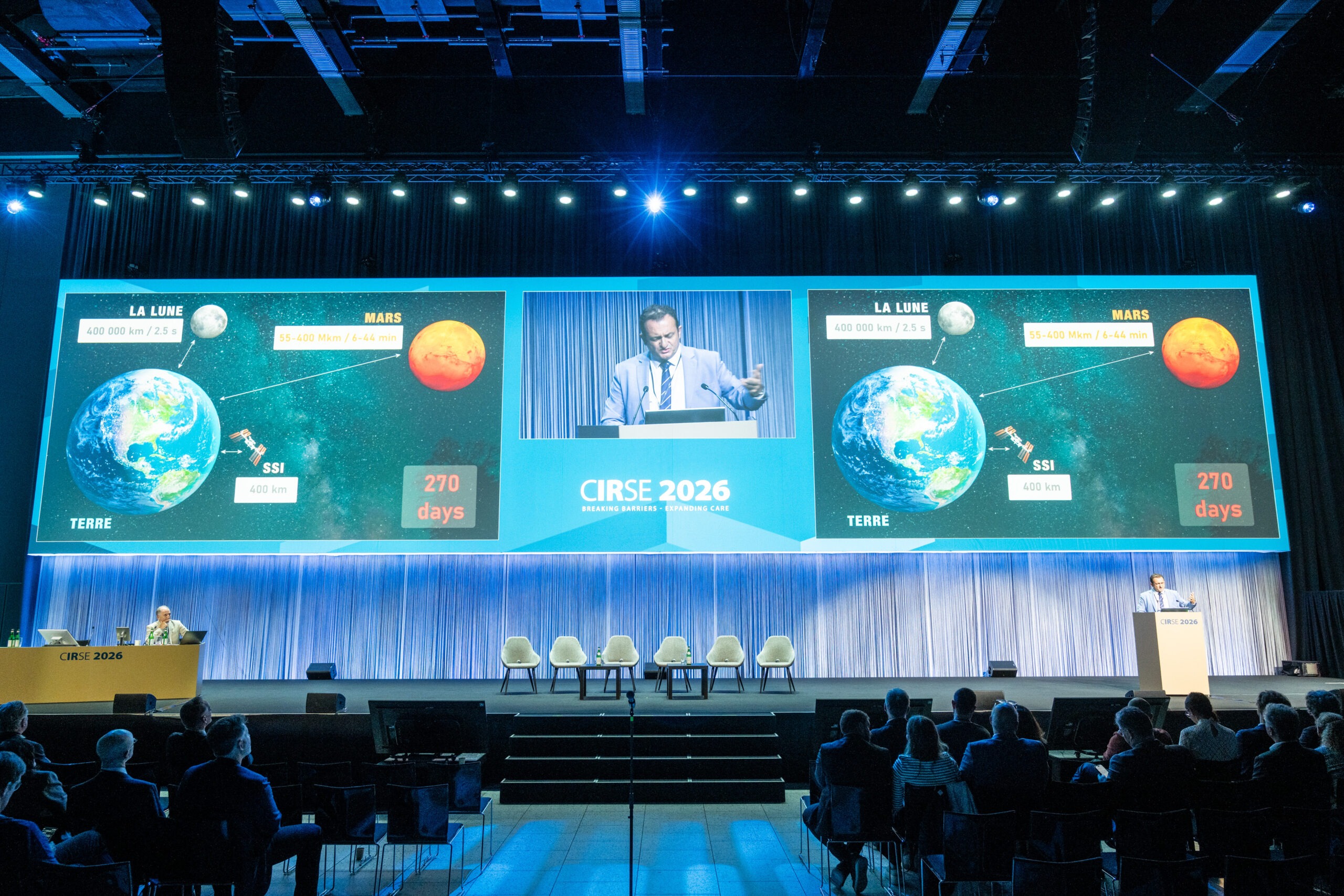
Vidal: The topic chose itself, in a sense. For several years now, I have been working on two challenges that initially seemed separate: bringing IR to places on Earth where it does not yet exist and imagining how IR could function in the extreme conditions of space. What struck me was the realization that these are not two parallel stories; they are the same question asked at different scales. How much can a procedure be stripped down, in terms of equipment, supply chain, and operator expertise, and still remain safe and effective? When I was invited to give the Gruentzig Lecture, I felt that this convergence from emerging countries to space was exactly the kind of horizon-setting reflection that an eponymous lecture calls for. Andreas Gruentzig was a pioneer who built something where nothing existed before. That spirit is precisely what we need to carry forward.
You spoke about your work training astronauts and analogue astronauts and even tested a ureteral drainage for renal colic during a microgravity flight yourself. What was that experience like? What did it teach you about adapting IR techniques for space?
Vidal: It was humbling and exhilarating in equal measure. We were aboard the Air Zero G plane, the former Airbus A310 with thirty parabolas, each giving us about thirty seconds of weightlessness to work in. The preparation sounds clinical on paper, but in reality, it is visceral: you feel the 2G during the ascent, then suddenly everything becomes weightless, and you have to work immediately and methodically within that window.
What it taught us above all was the four-hands rule: since you cannot fix your tools in place, every instrument has to be handed, held, and passed. Nothing can be set down. The other critical lesson was fluid management. In space, a single drop of urine escaping into the cabin could short-circuit electrical systems and endanger the entire mission. That forces a level of precision in every gesture. We showed that the procedure (both the Seldinger technique and direct trocar approach) is feasible in weightlessness, but it demands some rethinking of the choreography. That rethinking, I believe, will ultimately make us better operators on Earth as well.
You referenced John F. Kennedy’s famous words on space exploration. Why do you think it is important for medicine, and IR in particular, to look beyond challenges on Earth and anticipate what will be needed in space?
Vidal: Kennedy’s answer still holds: “We choose to go to the Moon to organize all our best energies and our techniques.” Space is not a distraction from earthly problems; it is a forcing function that concentrates our ingenuity. When every gram must be justified, when you cannot call an expert, when there is no resupply, you are forced to design solutions that are simple, robust, and operator independent. That discipline has always produced results that benefit life on Earth. Memory foam was designed to protect pilots under high G-forces; it is now in your mattress. CMOS sensors were miniaturized for interplanetary probes; they are now the cameras in every smartphone. Scratch-resistant lenses were developed for astronaut visors; they are now on virtually every pair of glasses. The same transfer will happen in medicine, and IR, precisely because it is minimally invasive, image-guided, and adaptable, is positioned to lead it.