
EBIR - IR Board Examination
Outline | Entry Criteria | The Examination | CIRSE Fellows
CIRSE is planning to introduce a European Board of Interventional Radiology in 2010. The first examination for this skill certificate will take place on October 1st, 2010, one day prior to the start of CIRSE 2010.
The European Board of Interventional Radiology (EBIR) will be a common European qualification in Interventional Radiology and will help to standardise training and expertise in Interventional Radiology across Europe.
We anticipate that the EBIR will represent a recognised qualification in IR and will assist IRs in the promotion of their skills and experience in IR when dealing with other clinical colleagues and with the general public.
The outline of the exam is provided below.
Outline
- The first examination will take place in Valencia in October 2010
- The basis for the examination will be the CIRSE Interventional Radiology syllabus
- The examination will consist of written and oral components
- The certificate is particularly aimed at junior interventional radiologists
- All European/ Full members of CIRSE can apply to sit the examination
- Corresponding members can not apply at this time
- The first examination will accommodate 15 candidates only.
- Please note that exam applications will be accepted on a first come, first served basis - date of receipt of application form! Early application is therefore recommended. Submission of accompanying material - see entry criteria below - must be done until May 1st, 2010 the very latest.
Entry criteria
a. A logbook of IR experience
b. Completed EBIR registration form (see link on left hand side of your screen)
c. A letter of support from the candidate’s IR programme director
d. A satisfactory curriculum vitae
e. An application fee of €500
f. European residency is required
Only European radiologists and/or radiologists residing within the boundaries of Europe as determined by the EBIR Board can apply. Applicants must register and provide documentary evidence of fulfilment of all entry criteria for the exam in 2010 no later than May 1st, 2010. Please note that no refunds can be provided if an applicant withdraws his/her application. If a candidate cannot provide all entry criteria by May 1st, 2010, his/her registration for the exam will be cancelled.
a. Logbook
All candidates should present a logbook with a total record of their IR experience in the previous 24 months.
The logbook should present the candidate’s IR experience in Vascular and Non-vascular Interventional Radiology.
Logbook Qualifications
The minimum qualifications required for entry to the examination are the following:
The candidate should have experience as first operator or first assistant in at least 150 IR procedures. (At least 25 procedures as first operator).
- 1. Vascular - Experience as first operator or first assistant in at least 100 procedures.
- 2. Non-vascular - Experience as first operator or first assistant in at least 50 procedures.
To download the CIRSE logbook, please click on the link on the left hand side of your screen.
The logbook should be countersigned by candidate’s IR programme director. The logbook should also be certified by the head of the candidate’s national IR society. If there is no identifiable national IR society for the candidate’s country, the logbook should be certified by the candidate’s national radiology society.
b. Registration form
The filled out registration form must be submitted to the CIRSE office. To download the application form, please click on the link on the left hand side of your screen.
c. Letter of support
The application must be accompanied by a letter of support from the candidate’s IR programme director.
This may be the head of the radiology department or the chief interventional radiologist in charge of the candidate’s training.
d. Curriculum Vitae
The CV should include a record of:
- Previous training posts in radiology and IR.
- All scientific and educational activities.
Candidates judged to have satisfied the entry criteria will be eligible to take the examination.
The Examination
The examination will consist of written and oral components. The maximum score for the two parts will be 100%. The examination will take place one day prior to the CIRSE congress.
a. The written exam
This will consist of 60 multiple choice questions.
- Single best answer format - (i.e. only 1 out of 4 possible answers correct).
- No negative marking for incorrect answers.
- The exam will last 90 minutes.
All candidates will be tested in
– Angiographic/CT/MRI anatomy and diagnosis
– Clinical practice
– Pathology
– General interventional knowledge (Materials et.)
– Image guidance
The MCQ exam will contribute 40% of the total score for the exam.
Each paper will be scored the day of the exam.
b. The oral exam
This will consist of two 30 minute oral examinations.
Candidates may choose two topics from the following list:
- General IR
- Vascular
- Non-vascular
- Oncology
Candidates will be asked to select their two topics at the time that they submit their application to take the exam.
Each candidate will be examined by two Fellows of CIRSE.
The examiners will show each candidate a series of cases relevant to the topic selected.
The examiners will test the candidate’s knowledge of all aspects of the cases under discussion – diagnosis, procedural details, equipment selection, outcomes, complications, etc.
Each 30 minute oral exam will contribute 30% of the score for the examination.
(Total score for the oral examination component of the EBIR = 60%).
Results
a. Examiner’s meeting
At the completion of the exam, an examiners meeting will be held. At this meeting, the results of both components of the exam will be added together to produce a total score for the examination for each candidate.
The scores for each candidate will be reviewed and potential fail candidates will be discussed. At the end of the meeting, a list of pass and fail candidates will be produced and candidates informed accordingly by email.
b. Awarding certificates
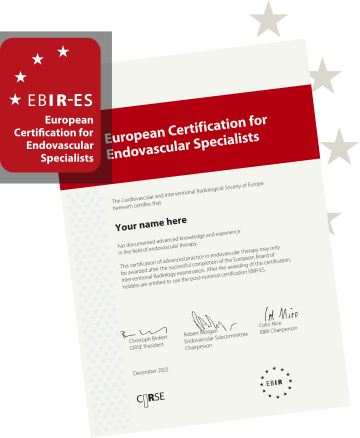
Successful candidates will be awarded a certificate. Successful candidates may add EBIR (European Board of Interventional Radiology) to their name.
Special regulations for CIRSE Fellows
CIRSE Fellows, who have applied for Fellowship before October 4th 2010 and if Fellowship is granted, are eligible to receive the EBIR without examination. EBIR application period will start on October 11, 2010 and will end on September 1, 2011. During the EBIR application period CIRSE Fellows will be able to complete a respective application form on the CIRSE homepage. CIRSE Fellows will have to certify that they
- must have published at least five articles in cardiovascular and interventional radiology, in internationally recognised, peer-reviewed scientific journals. Candidates must have been the first author of at least two these publications
- are willing to participate as examiner at future EBIR examinations
- that he/she is currently actively practicing Interventional Radiology
Only European radiologists and/or radiologists residing within the boundaries of Europe as determined by the EBIR Board can apply for EBIR.