
Cardiovascular and Interventional Radiological Society of Europe
Slider
SocietyEU projectsPreciseOnco

PreciseOnco

Project objectives

Cancer remains a leading health challenge, with approximately 2.7 million new diagnoses in Europe each year [1] with projections suggesting over 35 million new cancer cases globally by 2050, representing a 77% increase from 2022 [2].

In response to this growing challenge, interventional oncology has emerged as a rapidly evolving discipline that integrates medical imaging, oncology, and minimally invasive treatment approaches [3]. Such treatments – including targeted ablation, radioembolization, and electrochemotherapy – offer advantages over traditional surgery, such as shorter recovery times and fewer side effects; however, their effectiveness strongly depends on the performance of medical imaging and the precision with which physicians can guide instruments to tumors.
The PreciseOnco consortium aims to develop a suite of integrated technologies designed to take the next leap in precision cancer care. Central to the research and innovation program is spectral imaging, an advanced form of CT and cone-beam CT that captures significantly richer information about tissue composition than conventional imaging, enabling more confident differentiation between tumors, vasculature, and healthy tissue. By analyzing X-rays at different energy levels, spectral imaging enables physicians with greater clarity to see exactly what tissues they are treating.

To complement this advanced imaging technology, PreciseOnco will integrate robotic guidance systems that use real-time imaging data to guide interventional instruments (one or multiple needles) with sub-millimeter precision. The consortium will also look to advance electrochemotherapy, a minimally invasive technique that combines locally administered electrical pulses with chemotherapy to selectively treat cancer tissue, with the aim of maximizing tumor control while preserving surrounding healthy tissue.

Crucially, all these technologies will be powered by AI algorithms designed to enhance image quality, reduce radiation dose, streamline advanced visualization software and provide real time intra procedural feedback on treatment success. This would allow physicians to confirm that tumors have been fully treated before the patient leaves the operating room.

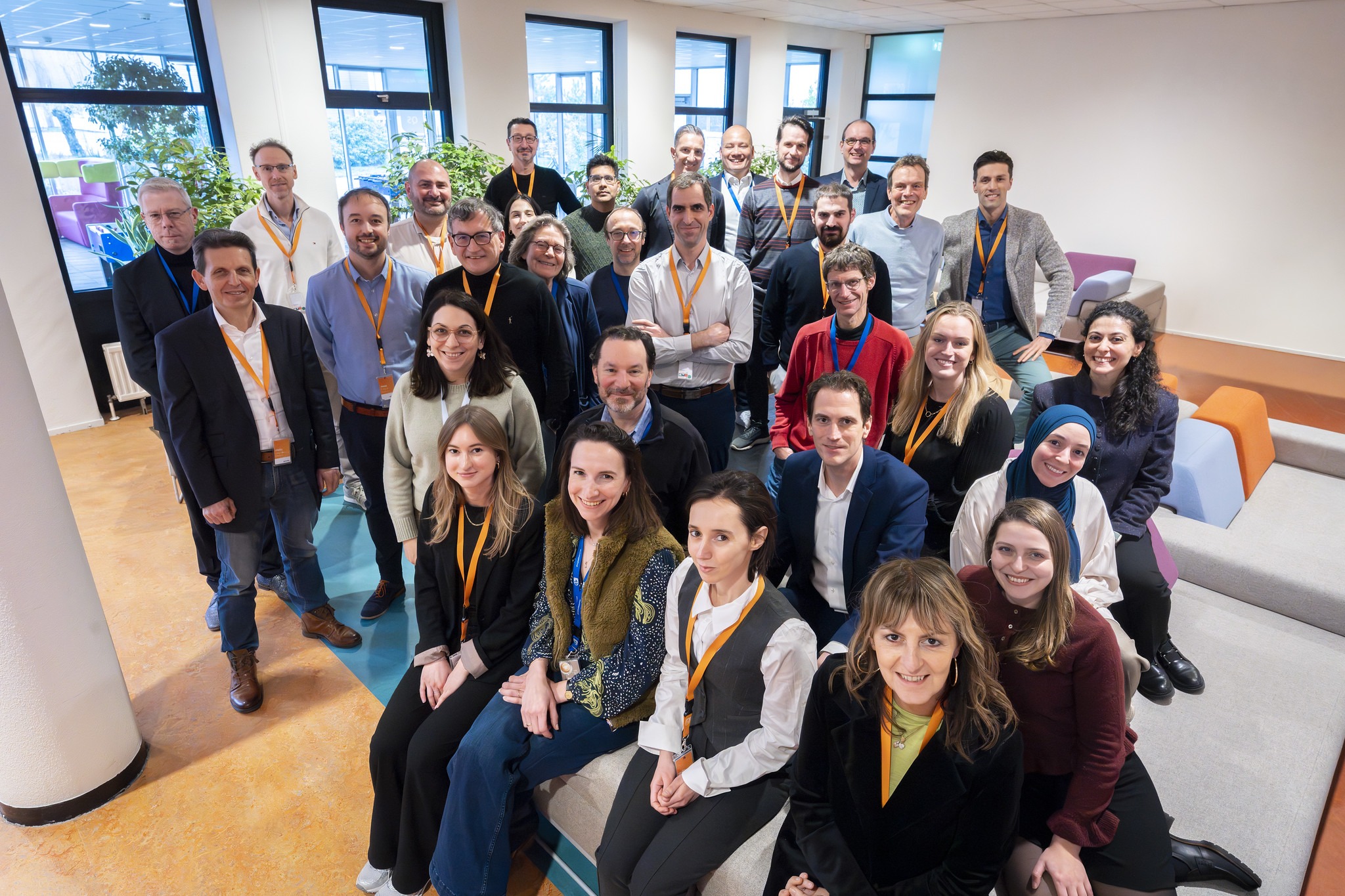
The PreciseOnco kick-off meeting in the Netherlands in January 2026

Clinical studies

PreciseOnco is a five-year research program with total budget of EUR 23.9 million and is structured into multiple work packages covering spectral imaging technology development, AI-based image processing, robotic guidance integration, multi-center clinical validation, and health economic assessment. PreciseOnco will conduct five clinical studies spanning multiple cancer types and interventional workflows, ensuring robust validation in real world clinical settings:

• VISTA (Virtual Spectral Imaging for Superior Thermal Ablation Guidance): Evaluating spectral imaging to improve liver, kidney ablation procedures and liver radioembolization.
• SPOT ON (Spectral angiography-computed tomography to Optimize percutaneous Tumor ablation): Assessing spectral CT for better tumor targeting and treatment planning.
• HORA EST HCC 2: Combining thermal ablation with transarterial chemoembolization (TACE) in a single session for improved hepatocellular carcinoma treatment.
• SPECTRA-L (Spectral Performance Evaluation of a CT-Equipped Therapeutic Radiology Angio Suite in Liver): Testing spectral imaging for transarterial chemoembolization (TACE) procedures.
• LASER (Locoregional therApies Spectral Evaluation of Responses): Developing imaging biomarkers to predict treatment success across multiple cancer types and interventional techniques.

Together, these studies will generate evidence to support the adoption of spectral imaging and robotic guidance across European cancer centers, extending access to advanced minimally invasive treatments to a larger patient population.

References

[1]    European Cancer Information System (ECIS) – jrc_CancerEstimates2022_factsheet.pdf.
[2]    World Health Organization (WHO) – Global cancer burden growing, amidst mounting need for services.
[3]    Global Interventional Oncology Market report – Interventional Oncology Market Size and Growth Analysis Report.

CIRSE’s role in the project

With its unique professional network, scientific expertise, and educational infrastructure, CIRSE is set to play an important role in supporting the validation, adoption, and dissemination of PreciseOnco innovations in the interventional oncology community. The society will lead the development and implementation of high-quality training and capacity building sessions to enhance end-users’ skills and knowledge related to the use of spectral imaging in the interventional space and facilitate the adoption of the PreciseOnco objectives, findings, and results.

Further information

To read the full press release announcing the PreciseOnco’s grant award from the EU’s Innovative Health Initiative (IHI), please click here.

The PreciseOnco project website will be available soon at www.preciseonco.eu. The CORDIS project page for PreciseOnco can be accessed here. The IHI factsheet for PreciseOnco can be found here.

For more information on CIRSE’s role in the project, please contact us at [email protected]

This project is supported by the Innovative Health Initiative Joint Undertaking (IHI JU) under grant agreement No. 101252582. The JU receives support from the European Union’s Horizon Europe research and innovation program and life science industries represented by COCIR, EFPIA, EuropaBio, MedTech Europe and Vaccines Europe. PreciseOnco is funded by the European Union, private members, and those contributing partners of the IHI JU. Views and opinions expressed are, however, those of the author(s) only and do not necessarily reflect those of the aforementioned parties. Neither of the aforementioned parties can be held responsible for them.
